
Emergency General Contractor Near Me: What Whitney Homeowners Should Do First
A burst pipe at 11pm is not a general contractor emergency first. It’s a shutoff valve, then a licensed plumber, then documentation for your insurance adjuster, and only then a GC. The most common and expensive mistake Whitney homeowners make is calling a “handyman GC” during the panic window, letting unpermitted emergency repairs happen before the damage is documented, and unknowingly putting their claim coverage at risk. Here’s the sequence that protects both your home and your insurance check.
Why the First Call Usually Isn’t a General Contractor

When water is pouring through a ceiling or a wall is bowing, your instinct is to call the person who fixes houses. But in the first hour, the job isn’t remodeling. It’s stopping the source and proving what happened. A general contractor’s real value starts once the bleeding stops – coordinating the rebuild, pulling permits, and managing trades so the work is done to code.
That order matters in Whitney because of how the local climate stresses homes. We sit in a desert basin where summer temperatures push past 110°F and the monsoon season dumps a month of rain in a few hours. That swing is brutal on supply lines, roof flashing, and stucco. In our experience, the failures we see in neighborhoods like Painted Hills and Whitney Ranch often trace back to heat-cracked plumbing or a roof that dried out and separated from its flashing during a dry spell, then leaked the first time it rained hard.
Understanding what’s actually an emergency versus what can wait until morning saves most homeowners a panic surcharge. If you’d rather not sort that out alone at midnight, call (833) 721-7402 and a live person will talk it through with you – no voicemail, no callback window.
Your First Two Hours: A Step-by-Step Sequence for Water, Roof, and Structural Emergencies
Here’s how to handle the three emergencies that actually happen in Whitney homes, in the order you should do them.
1. Water Intrusion (Burst Pipe, Water Heater Failure, Overflow)
- 1
Shut off the water. Find your main valve – usually at the meter or where the line enters the house – and turn it clockwise until it stops. If you can isolate the failure with a fixture valve, do that.
- 2
Kill the power to wet areas. If water is near outlets, appliances, or a panel, shut off the breaker to that zone before you step in. Standing water and live circuits are a fatal combination – don’t test it.
- 3
Document before you clean. Photos and video of the water line on the drywall, the soaked carpet, the failed pipe. Timestamp everything. Your adjuster needs the “before,” not the tidy version.
- 4
Call a licensed plumber to stop the leak at its source. That’s a trade call, not a GC call.
- 5
Call a water-damage or restoration pro to extract water and start drying. Mold can begin colonizing wet drywall in 24 to 48 hours in Whitney’s heat.
- 6
Then call a GC for the rebuild – drywall, substrate (the moisture-resistant layer behind your tile), cabinets, flooring.
2. Roof Damage
Active leaks and missing shingles after a wind event get tarped – that’s stabilization, not repair. Get the roof tarped fast by a roofer, photograph the damage from the ground, and don’t climb up yourself. Height work is where people get hurt.
3. Structural Concern (Cracked Wall, Sagging Ceiling, Bowing Floor)
If a wall has cracked suddenly, a door no longer closes, or a ceiling is sagging, evacuate the room, don’t add load to the floor above, and call a structural professional for an assessment before anyone starts tearing into it. Emergency shoring is a specialty task.
The Documentation You Must Gather Before Any Contractor Starts Work

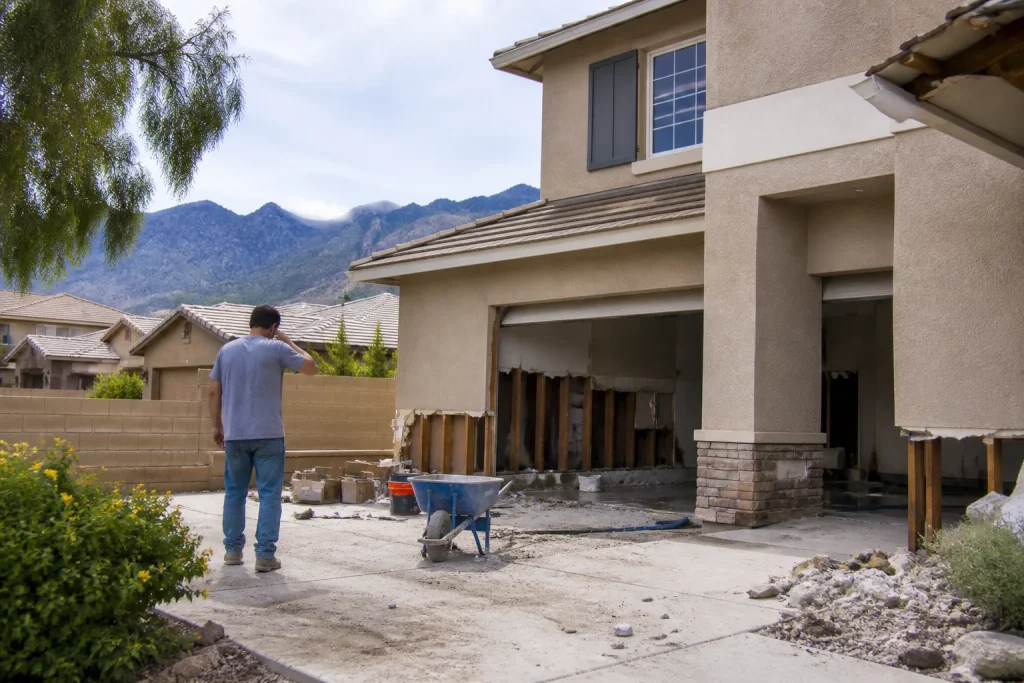
This is where we see claims get denied. If a contractor starts ripping out before the damage is documented, the adjuster walks into a hollowed-out wall with no evidence of the original failure. In our experience, homeowners who spend ten minutes gathering the right material end up with smoother, larger settlements than those who “got it cleaned up quick.”
Collect and save this before anyone touches a thing:
- Wide shots and close-ups of the damage, with something for scale, plus the water line or crack visible.
- A timestamped video walkthrough narrated out loud – what you see, when it started, what you did.
- Receipts for anything you bought (fans, tarps, towels) and any emergency service call.
- Your policy number and a claim note logged with the date and time you called your insurer.
- The failed component if it’s removable – the split pipe fitting, the broken valve – so it can be inspected.
We pulled a water-damaged vanity cabinet out of a home over in Whitney Ranch last spring where the homeowner had the foresight to video the whole thing before we touched it. The adjuster had everything she needed in one file, and the rebuild moved without a single back-and-forth. That ten-minute video saved weeks.
Stabilization vs. Repair: What a GC Can Do Immediately, and What Needs a Permit
Here’s the distinction that trips people up: emergency stabilization is not the same as the repair, and the two have different rules.
Stabilization – tarping a roof, shutting off a line, boarding up a window, extracting water, shoring a wall – is work done to stop further damage. A GC can move on this quickly, and your insurer generally expects you to protect the property.
Repair and rebuild – replacing drywall, re-tiling a shower, reframing, re-running plumbing or electrical, installing cabinets – is construction, and in Whitney that means permits and inspections for anything structural, electrical, plumbing, or mechanical. Even after an emergency, a real repair still needs a permit. A contractor who tells you “we’ll skip the permit, it’s just a repair after a flood” is telling you they don’t intend to protect your coverage or your home’s future resale.
Penhallow operates under the Kingswell standard: a written price before any work starts, a defined arrival window, and a written guarantee on every project. When you’re hiring under time pressure, that written number is your best protection – ask for it in writing, not verbally, before the first board is pulled. If you’re planning the rebuild side and want to see how we scope that work, our General Contractor in Whitney page walks through the process.
Emergency Pricing: What’s Legitimate and What’s Price Gouging

After-hours work does cost more – a crew called out at midnight, a supply run, weekend labor. Legitimate emergency markup is real. So is gouging, and the line between them is usually whether you got a written price before the work started.
What’s reasonable: a stated after-hours call fee, an hourly rate that’s higher on nights and weekends, and a documented line-item for materials. What’s not: a vague “we’ll figure it out after” number that balloons once the wall is open, cash-only demands, or pressure to sign before you’ve seen a written figure.
In our experience, the single most protective thing you can do in a crisis is demand the number in writing before anyone starts. A written price you can hold a contractor to is worth more than a handshake and a promise, especially at 2am. Call (833) 721-7402 for an exact quote – estimates are free, and on a planned rebuild you’ll get that number in writing before work begins.
How to Vet a General Contractor Under Time Pressure
You don’t have time for three weeks of research when your ceiling is sagging. Here’s a short checklist you can run in fifteen minutes.
- State-licensed and insured. Ask for the license and the certificate of insurance. A real contractor produces them without a story.
- Written price before work starts. If they won’t put it in writing, they’re not the one.
- Permits pulled and inspections passed. Ask directly: “Will you pull the permit for this?” The answer should be an immediate yes.
- Written guarantee on the repair. Penhallow’s is the 365-Day Done Right Promise – if it’s not done right inside the guarantee period, we come back and fix it at no charge, backed in writing on every project.
- Background-checked, uniformed technicians. You should know exactly who’s walking into your home during a stressful time.
- A live person answers the phone. Not an answering service, not a voicemail maze. A real human, any hour.
Materials matter too. When the rebuild reaches the finish stage, we install brands with their own backing – KraftMaid and Wellborn cabinetry, Cambria and Silestone countertops, Kohler and Moen fixtures, American Standard and Toto for plumbing, James Hardie siding – so the products hold up alongside our guarantee. Our technicians have up to 22 years of experience with these lines.
When to call a pro: if water is still moving, if anything structural is involved, or if you’re unsure whether a permit is required, stop and call. That’s not a DIY moment. You can always start with our Penhallow Remodeling Whitney home page to see the full range of what we handle.
Related services in Whitney: If the emergency flows into a rebuild, we handle Bathroom Remodeling in Whitney and Kitchen Remodeling in Whitney – both common after a water event takes out cabinets or a shower surround.
The Bottom Line
In a Whitney home emergency, the order is: stop the source, document everything, call the right trade, then call a GC for the rebuild. Stabilize now, permit the repair, and insist on a written price and a written guarantee before anyone starts. That sequence protects your insurance claim as much as it protects your house.
If you’re in Whitney and need help with the rebuild side, Penhallow Remodeling Whitney offers free estimates – call (833) 721-7402. A live person answers 24/7, and you’ll get a written number before work starts.
Frequently Asked Questions
Usually not first. For active water, a burst pipe, or electrical risk, shut off the source and call a licensed plumber or the utility, document the damage, then bring in a GC for the rebuild. A GC is the right call once the immediate danger is stopped and you’re moving into repair and reconstruction.
Yes, it can be. If unpermitted or undocumented repairs start before the damage is photographed and logged, an adjuster may reduce or deny the claim. Photograph and video the damage first, keep receipts, and let the insurer see the “before.” Call (833) 721-7402 for help sequencing a rebuild that keeps your claim intact – estimates are free.
Any repair touching structural, electrical, plumbing, or mechanical work needs a permit and inspection, even after an emergency. Only pure stabilization – tarping, water extraction, boarding up – skips the permit. Insist that your contractor pulls the permit and passes inspection; that protects your home’s future sale.
Expect a legitimate after-hours markup on labor and a stated call fee, with the actual number given in writing before work begins. What you should never accept is a vague figure that balloons after the wall is open. Demand a written, line-item price up front. Call (833) 721-7402 for a free estimate on the rebuild – and the number you get is the number on the invoice.
Written by the team at Penhallow Remodeling Whitney.
Need Construction Help?
Call Penhallow Remodeling Whitney - licensed & insured, here with fast after-hours help in Whitney.
(833) 721-7402